Absolute Precision. Unrestricted Capacity.
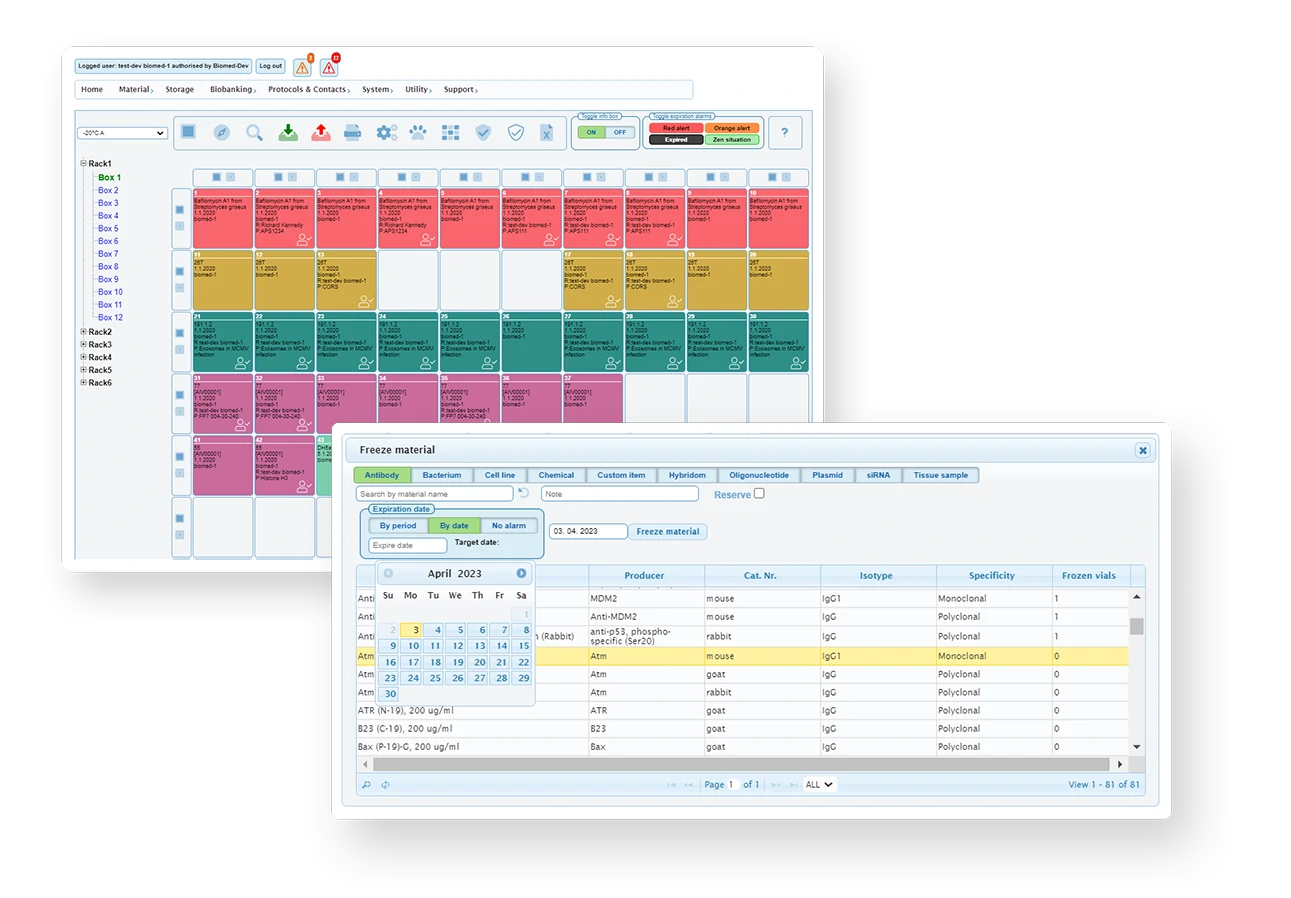
Stop hunting through physical racks and relying on outdated spreadsheets. LABA’s Virtual Storage module is bespoke built to create an exact digital twin of your laboratory's infrastructure. Whether mapping liquid nitrogen tanks, -80°C freezers, or ambient shelves, you gain unrestricted scale to mirror your exact physical capacity and effortlessly track every vial's location.
Digital Asset Replication
Create unlimited virtual representations of your storage units. Replicate your exact physical layouts—down to the specific tower, rack, box, and individual grid coordinate.
Automated Expiry Control
Experience fast and user-friendly storage management. Set automated, four-level expiry alarms to ensure timely usage of sensitive materials, effectively preventing experimental waste.
One-Click Space Discovery
Never guess where space is available again. The intuitive dashboard showcases updated box contents and highlights free space instantly, streamlining the placement of incoming samples.
Effortless Navigation Meets Rigorous Auditing
We engineered the Virtual Storage Module to eliminate human error. By allowing users to select precise storage locations digitally before physically placing their reagents, the system ensures a perfectly organized cold-chain. Only pre-defined, approved items can be stored.
Enjoy complete control over your stored content. Every item placed into or removed from virtual storage is meticulously logged by date and user, providing a comprehensive, audit-ready overview of all your facilities.
-
100% Bespoke Customisation
We custom-build grid layouts and container types to precisely match your laboratory's unique physical hardware.
-
Unlimited Storage Mapping
Create infinite digital profiles for refrigerators, cryo-tanks, and ambient units with zero per-unit penalties.
-
User-Specific Audit Trails
Track exactly who deposited, moved, or removed a sample, complete with granular timestamp logging.
-
Error-Proof Placement
The system actively prevents users from assigning items to occupied coordinates, eliminating sample loss.