Where Standard LIMS Platforms Fail: Crisis vs. Control
Physical specimen relocation is the single highest-risk moment in any repository's operational lifecycle. Whether reacting to an emergency freezer failure or consolidating precious oncology cohorts, relying on disconnected spreadsheets leads to sample transposition, accidental overwrites, and unrecorded thermal exposure. Explore how LABA transforms high-stress relocations into verified, audit-ready procedures.
Scenario 1: The 17:30 Compressor Alarm (−80°C Freezer Failure)
A −80°C compressor fails late on a Friday afternoon. 2,400 irreplaceable clinical trial aliquots across 24 racks must be evacuated into backup cold storage before the internal temperature breaches the −60°C glass transition threshold.
- Technicians manually copy-paste hundreds of rows across disconnected Excel sheets with frozen fingers.
- High risk of coordinate transposition; vials placed in wrong boxes without spatial verification.
- Time-Out-of-Refrigeration (TOR) is unrecorded or guessed, permanently breaching regulatory compliance.
- Accidental overwrites occur silently if target destination boxes already contain existing stock.
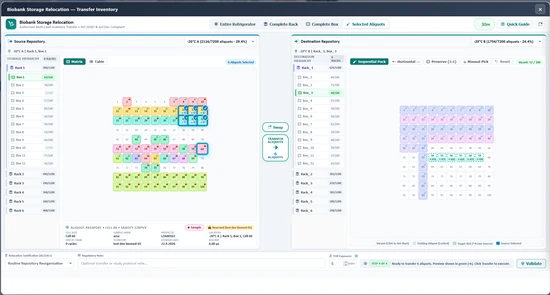
- 1-Click Entire Refrigerator Evacuation: Migrates all 24 racks to backup storage in under 15 seconds.
- Zero Collision Shield: Occupied slots in destination units are automatically locked.
- Automated TOR Chronometer: Records exact bench-time exposure directly against each vial.
- 60-Second Crimson Rollback: Instant undo buffer provides a safety net if wrong units are targeted.
Scenario 2: The Space Defragging Puzzle (Reclaiming 35% Cold Storage)
Liquid nitrogen vapour storage and ultra-low freezers operate at maximum capacity, with 40 half-empty boxes scattered across multiple racks. Biobanks need to consolidate empty slots to defer costly capital equipment purchases.
- Exhausting cell-by-cell moves using tweezers while cross-checking paper printouts.
- Accidental double-booking of grid slots leads to sample displacement or permanent loss.
- Study cohort cohesion is severed, making future sample retrieval tedious and slow.
- Days of technician labor wasted on administrative data entry rather than research.
- Intelligent Sequential Auto-Pack: Packs fragmented vials into consecutive slots automatically.
- Visual Spatial Preview: Directional indicators (
→#18) show target destinations before commitment. - Preserve 1:1 Coordinates: Retains relative spatial arrangement when moving entire boxes.
- Immediate Capacity Reclaim: Consolidates fragmented boxes to free up to 35% storage space safely.
Scenario 3: The Unannounced ISO 20387 / HTA Audit Inspection
An external auditor or regulatory inspector selects an arbitrary oncology aliquot in Box 4, Cell 28 and demands immediate proof of custody, operator identity, justification, and thermal handling history.
- Staff scramble through paper logbooks, archived spreadsheets, and legacy email threads.
- Missing operator attribution; impossible to verify who authorised or performed the transfer.
- Zero verifiable proof of room-temperature exposure duration during bench transit.
- Audit non-conformity issued under ISO 20387 Clause 7.2 for broken chain of custody.
- Live Aliquot Passport Audit: Displays authenticated operator, workstation, and exact timestamp.
- Mandatory Reason for Change: Captures standard justification codes (e.g. Routine Defrost).
- Certified TOR Proof: Verifies exact bench exposure duration (minutes and seconds) for inspectors.
- Immutable ALCOA+ Audit Ledger: Full lineage preserved in high-integrity database records.
Engineered Safeguards for Every Relocation
Zero Slot-Collision
Destination cells containing existing inventory are permanently locked. The engine physically prevents accidental duplicate placements or overwrites.
Aliquot Passport HUD
Inspect sample names, patient IDs, freeze-thaw cycles, storage dates, and remaining volumes directly from the relocation grid in real time.
TOR Thermal Guard
Active Time-Out-of-Refrigeration chronometer records exact bench exposure minutes against every transferred specimen, fulfilling ISO 20387.
60s Crimson Rollback
A safety net for human errors. Following any transfer execution, a single-click rollback button instantly restores prior coordinates without data loss.
Audit-Ready Chain of Custody Meets Total Operational Control
Whether managing an unexpected midnight compressor failure or consolidating a multi-year clinical trial cohort, specimen relocation cannot rely on manual paper checklists. LABA provides a structured multi-level transfer wizard that prevents errors at every stage of the transfer lifecycle.
Move an entire -80°C freezer, relocate an entire rack, transfer complete boxes, or hand-pick individual research vials. Every single movement captures authenticated user credentials, time elapsed, and standard regulatory justifications to satisfy the strictest external inspections.
-
ALCOA+ Attributable Access Governance
Enforces authenticated sign-off, selectable reason for change (Defrost / Maintenance, Study Protocol, Space Optimisation), and immutable audit logs.
-
Supports ISO 20387:2018 Standards
Fulfills Clause 7.2 requirements for biospecimen reception, handling, transfer traceability, and cold-chain compliance.
-
Live Aliquot Passport Inspection
Inspect vial IDs, patient IDs, freeze-thaw history, storage dates, and volumes in real time directly from the transfer screen.
-
Zero Slot-Collision Guarantee
Occupied cells in destination units are automatically locked. The system prevents duplicate slot assignments and overwriting existing stock.
Connected Cold-Chain & Specimen Governance
Map destination units into interactive digital twins with our Virtual Storage Module, or manage full aliquot lineages via Bespoke Biobanking Software.
Storage Relocation in Practice
Can we relocate an entire -80°C freezer or cryogenic tank at once during an emergency?
Yes. LABA's Storage Relocation module supports four distinct operational levels: Entire Refrigerator, Complete Rack, Complete Box, or Selected Aliquots. During emergency defrosts or mechanical failures, an entire unit's contents can be mapped and migrated to backup storage in seconds with complete spatial lineage preserved.
How does the system ensure specimens are not assigned to already occupied cells?
The relocation engine enforces a zero slot-collision guarantee. Occupied slots in destination boxes are strictly locked, and the system visually previews target coordinates with directional indicators (→#18) before any transfer occurs, preventing accidental overwriting of valuable specimens.
How does the module support ISO 20387:2018 and ALCOA+ compliance?
Every relocation action enforces authenticated sign-off, selectable pre-set justifications (such as Defrost/Maintenance, Study Protocol Consolidation, or Space Optimisation), optional regulatory notes, contemporaneous timestamps, and Time-Out-of-Refrigeration (TOR) tracking, creating an immutable audit trail compliant with ISO 20387:2018 Clause 7.2.
Can we undo a relocation if a technician selects the wrong destination box?
Yes. The module provides a 60-second instant rollback buffer following transfer execution, allowing the operator to reverse the relocation in a single click before transactions are finalized into permanent cold storage records.
What software manages an emergency biobank freezer breakdown without losing sample coordinates?
LABA provides dedicated emergency evacuation workflows allowing laboratory personnel to evacuate an entire -80°C freezer or cryogenic tank to backup units in four clicks. The system maintains complete spatial coordinates, checks for destination cell occupancy, logs Time-Out-of-Refrigeration (TOR), and generates an immutable ALCOA+ audit trail.
How do biorepositories consolidate fragmented or half-empty cryo boxes under ISO 20387?
LABA features intelligent auto-packing and intra-box compaction algorithms. Technicians can consolidate aliquots from multiple low-occupancy boxes into high-density storage with zero slot collisions, contemporaneous electronic signatures, and automated audit logging satisfying ISO 20387:2018 Clause 7.2 requirements.