Answer First: To migrate a -80°C biobank off Excel without disrupting active bench work, freeze one canonical copy of your spreadsheets, split combined location strings into four discrete fields (Unit, Rack, Box, Coordinate), check for silent Excel date coercions on sample IDs and HLA alleles, and validate one representative freezer inside a staging environment before cutting over the full archive.
1. Five Failure Modes That Appear First in Freezer Spreadsheets
- Coordinate Drift After Partial Thaws: A technician pulls vial C4 for an assay, forgets to clear the cell, and six months later a colleague assumes the slot is still occupied.
- Silent Date Coercion: Spreadsheets routinely convert hyphenated sample IDs, gene names, or HLA alleles (such as
02:01orOCT4) into calendar dates or time serials. - Unsynchronised Copies: Multiple versions named
Freezer2_FINAL_v3.xlsxsit on shared drives and local desktops simultaneously. - No Attributable History: When an inspector asks who thawed or relocated an aliquot 14 months ago, spreadsheet cells only show the latest overwritten text.
- Emergency Evacuation Bottlenecks: Moving 20 racks during a compressor failure cannot be recorded cleanly cell-by-cell under time pressure.
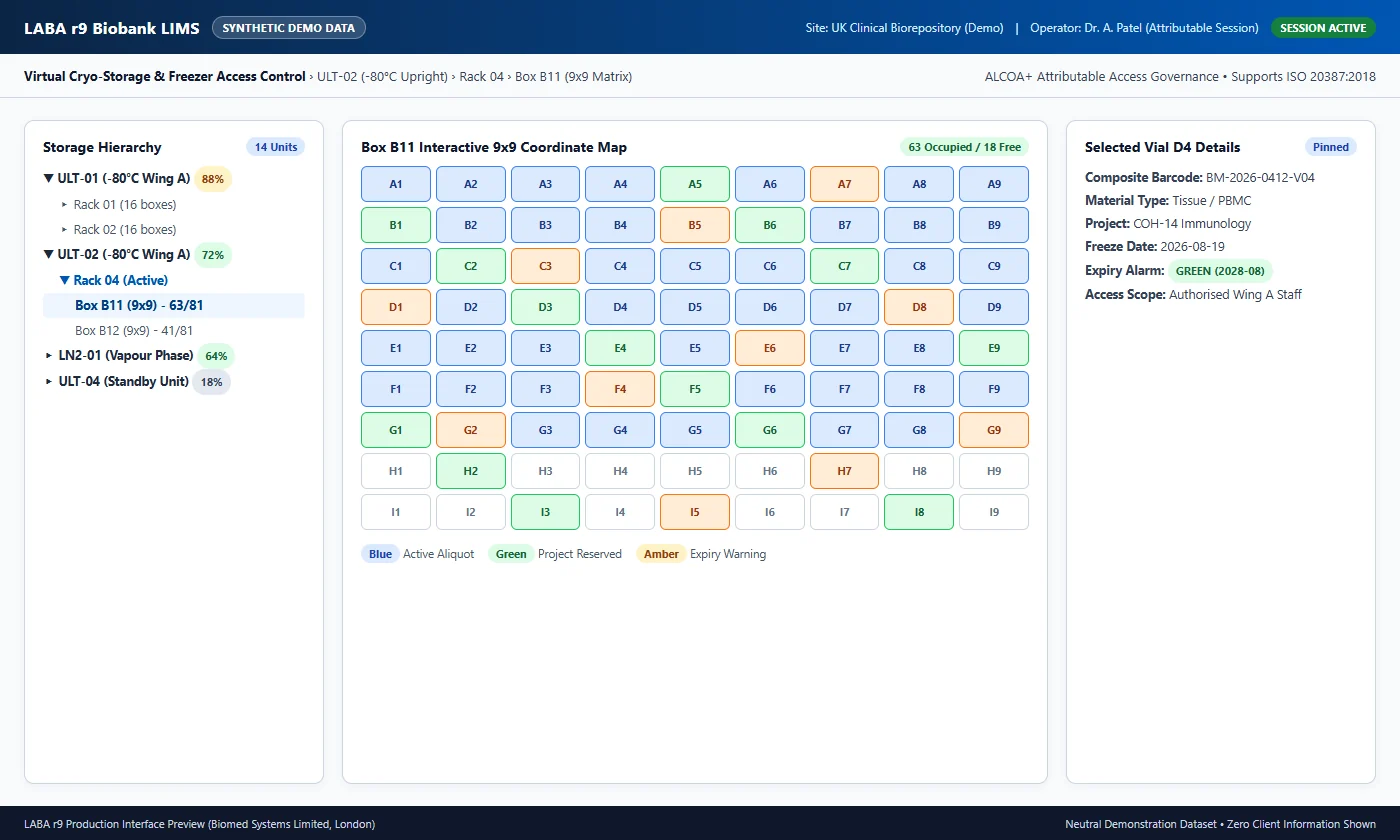
2. Pre-Migration Spreadsheet Cleaning Checklist
- Standardise Physical Hierarchy Labels: Confirm every freezer, shelf/rack, and box has one unambiguous naming convention (for example,
ULT-02 / R04 / B11) matching physical rack labels. - Normalise Grid Coordinates: Convert mixed notations (
Row 3 Col 4,3,4,C-04) into uniform coordinates matching your physical 9x9, 10x10, or 8x12 cryoboxes. - Flag Duplicate Vial Identifiers: Run a duplicate check on composite barcodes and material names so parent material cards do not collide on import.
- Separate Pseudonymised Donor IDs: Keep direct patient identifiers outside sample inventory spreadsheets; import pseudonymised study/donor codes only.
- Export Sample Sheet as UTF-8 CSV: Inspect the raw text file in a plain editor to verify Greek units (μl, °C) and leading zeros were not stripped.
3. Neutral Comparison: Spreadsheets vs. Structured Biobank LIMS
| Operational Task | Excel Workbooks | Structured Biobank LIMS (e.g. LABA r9) |
|---|---|---|
| Locating 1 vial across 6 freezers | Open multiple workbooks and tabs; verify version date | Single global search jumping straight to the exact pulsing box coordinate |
| Evacuating a failing -80°C unit | Manual cut-and-paste across dozens of sheets | Dual-pane bulk rack/box transfer with 60-second undo and atomic audit entry |
| Preventing accidental record deletion | Anyone with write access can delete rows silently | Database lock blocks deleting any material card with frozen vials in storage |
| Inspection audit trail | None; manual reconstruction from backups | Append-only attributable log with named user, UTC timestamp, and Reason for Change |
4. Frequently Asked Questions
When has a laboratory outgrown Excel for -80°C sample tracking?
Most laboratories hit the breaking point once they exceed 1,500 to 2,500 cryovials across two or more freezers, or when three or more technicians edit shared inventory files. At that scale, file-locking conflicts, silent copy-paste shifts, and missing audit history begin costing hours every week.
Do we need to clean every legacy spreadsheet manually before testing a LIMS?
No. Start with one representative freezer and one anonymised sample sheet. Profiling that single slice inside a structured staging environment quickly surfaces duplicate coordinates, malformed dates, and column inconsistencies before you tackle the entire archive.
Next Practical Step: Score your current freezer utilisation and spreadsheet drift using our free -80°C Freezer Capacity & Readiness Checker, or validate one real anonymised spreadsheet inside a 14-Day Real Data Sprint (£1,250, 100% credited to setup).