1. Eliminating Shared Logins (The Hidden Audit Trap)
The single fastest way to fail an ALCOA+ attribution review is a shared bench account (such as labuser1). Shared credentials almost always stem from commercial per-seat licensing: labs buy five paid seats for fifteen people to keep annual budgets under control. Moving to a flat annual licence lets every technician, Principal Investigator, PhD student, and QA auditor hold an individual named account backed by an automatic inactivity session watchdog.
2. Four Technical Controls Expected During Biobank Inspections
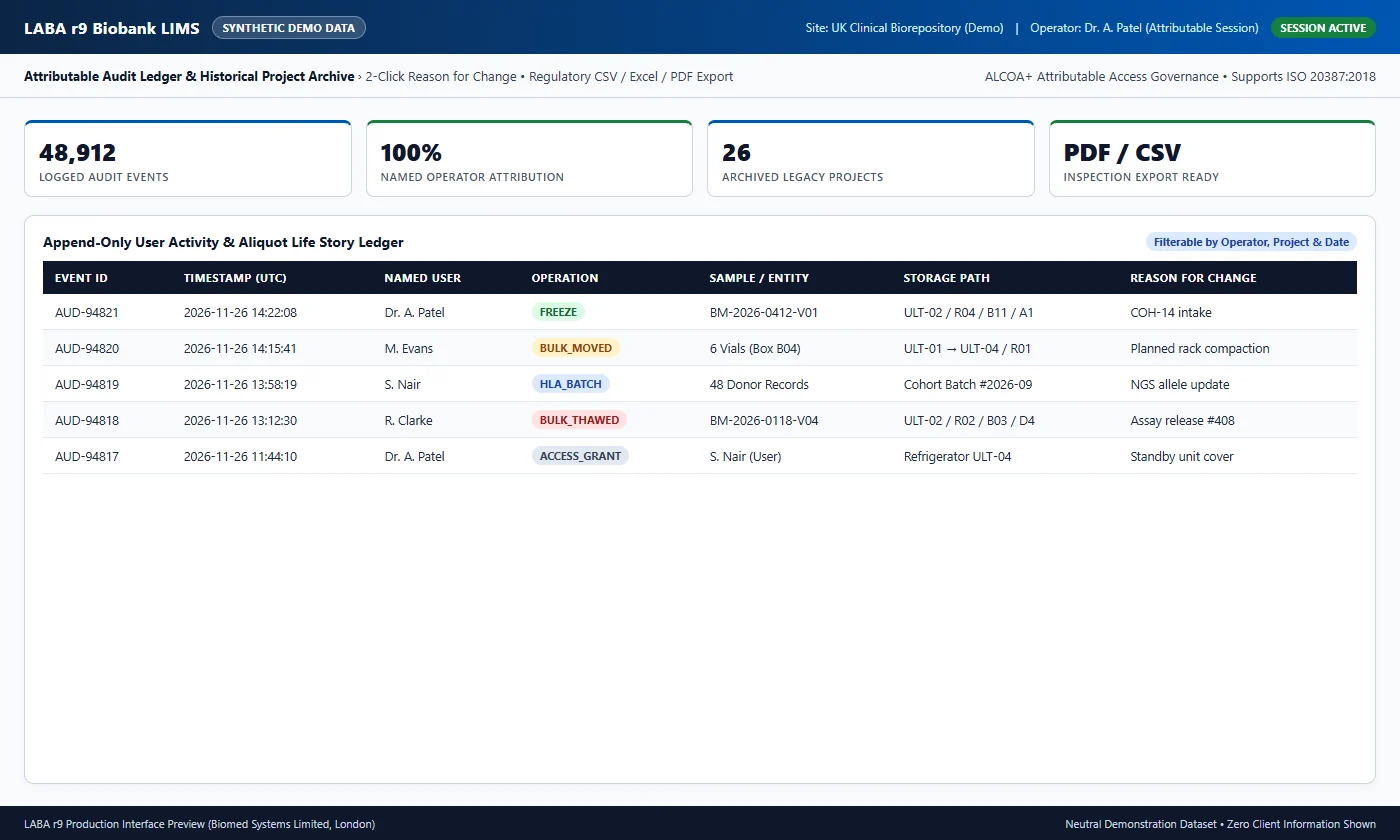
- Attributable & Contemporaneous Event Logging: Every freeze, unfreeze, project reservation, and relocation must capture authenticated operator name, UTC timestamp, composite barcode, and human-readable storage path (
Unit / Rack / Box / Cell). - Low-Friction Reason for Change: If capturing a change reason requires five slow screens, bench staff will bypass it. A 2-click Reason for Change modal keeps workflows fast while recording clear justification for every edit.
- Emergency Freezer Evacuation & TOR Documentation: When a compressor fails, operators need to transfer whole racks into a standby -80°C unit in seconds, attach TOR notes to the batch, and rely on a 60-second undo bar that logs both the move and any corrective reversal permanently.
- Per-Refrigerator Access Boundaries: Restricted clinical cohorts should only be visible and editable by authorised personnel, with every permission grant or revocation itself written to the audit ledger.
3. Frequently Asked Questions
Why do per-seat LIMS pricing models create audit-trail risk?
When software vendors charge £1,000+ per named user per year, laboratories often share a single generic bench login across technicians or visiting PhD students. Shared logins immediately break ALCOA+ attribution because audit logs can no longer prove which individual thawed, moved, or edited a sample.
Does purchasing LIMS software automatically make a biobank ISO 20387 accredited?
No. Software supplies technical controls such as attributable logins, append-only audit logs, and Reason for Change prompts, but ISO 20387:2018 accreditation and HTA compliance depend on the laboratory’s full quality management system, validated SOPs, physical cold-chain monitoring, and staff training.